Why every serious podcast needs a clipping network
A podcast is not a content channel. It is a media asset, a sales channel and a distribution system, and most companies waste all three by publishing to one account and hoping.
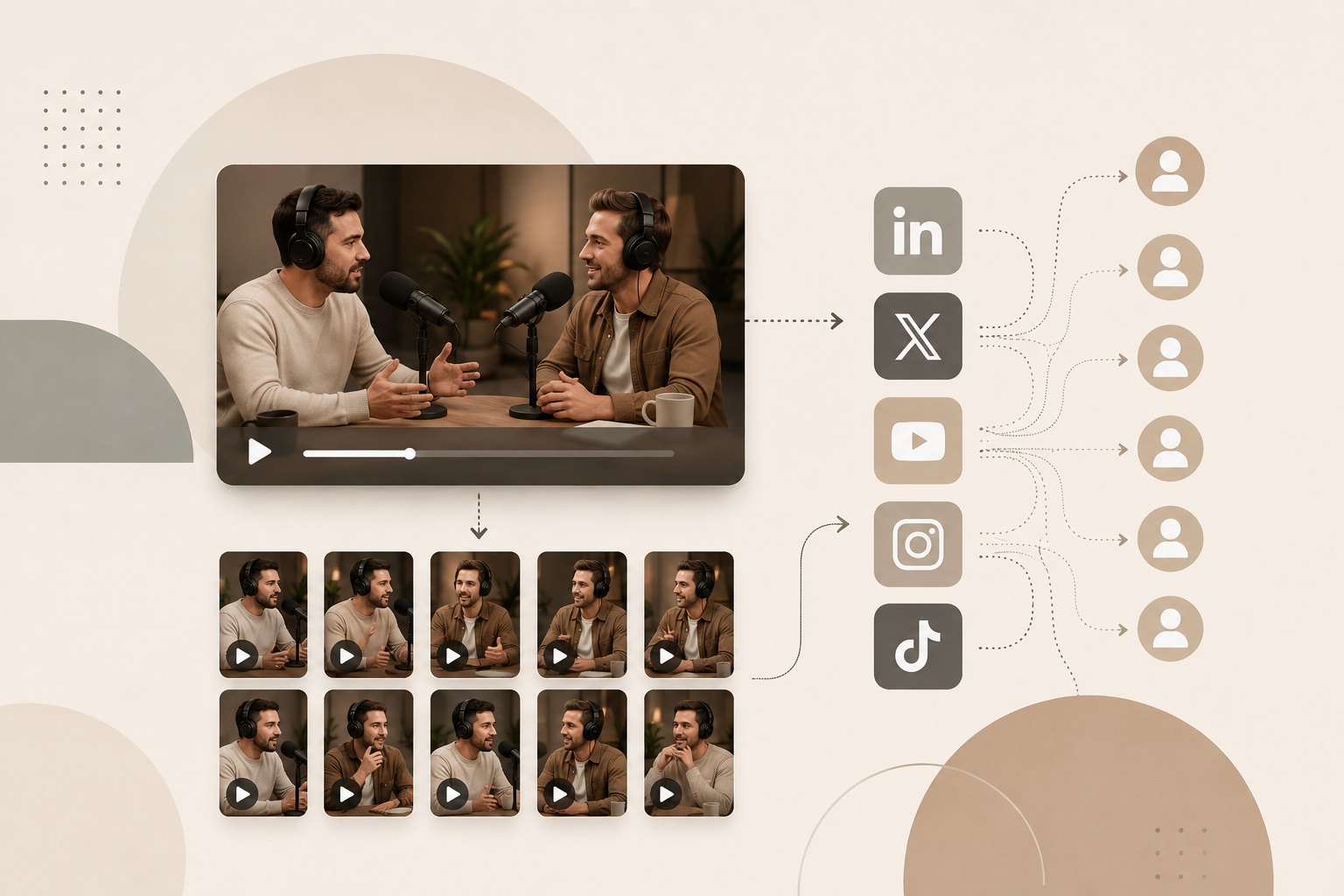
Most companies think about podcasts as a content channel.
I think that's too narrow.
A podcast can be a media asset, a sales channel, a relationship-building engine, and a brand distribution system at the same time.
But there is one problem:
A great podcast is worthless if nobody sees it.
And that's where most podcasts fail.
They invest heavily in recording great conversations, booking impressive guests and producing a polished episode.
Then they publish it on one YouTube channel, one LinkedIn page, one Instagram account and wait for the audience to come.
That isn't a content strategy.
That's publishing.
The real question is:
How do you turn one podcast conversation into a distribution engine for the business?
I believe the answer is a clipping network.
But before getting into that, let's understand why companies start podcasts in the first place.
Why do companies start podcasts?
There are three major reasons.
1. Audience and monetisation
The obvious one.
Build an audience, generate attention and eventually monetise that attention through sponsorships, advertising and brand partnerships.
The bigger the audience and the more valuable the demographic, the more valuable the inventory becomes.
But this is only one use case.
For many B2B companies, there are two much more interesting ones.
2. The one big deal
Imagine you're a B2B fintech company selling enterprise software.
Your average contract is worth $100K a year.
One customer is worth $1.2M over a multi-year relationship.
There might only be 50 companies in the world that are truly ideal customers for you.
Now imagine the Head of Sales, CFO or CEO of one of those companies is sitting across from you for an hour.
Not on a cold sales call.
Not in a demo.
On your podcast.
You have a conversation.
You learn about their business.
They learn about yours.
You build a relationship.
You give them a tour of your office.
And if you're good at sales, that relationship can eventually become a customer.
Suddenly, the podcast isn't a media expense.
It's an enterprise sales channel.
One customer can potentially pay for years of podcast production.
3. Brand and category creation
This is where companies like Stripe provide an interesting example.
A company doesn't always create content because it wants to generate direct revenue from the content.
Sometimes the objective is much bigger:
Own mindshare.
If founders, developers, CFOs or operators repeatedly see your brand associated with intelligent conversations and useful insights, your company gradually becomes more familiar.
And familiarity matters.
Imagine six months from now you need a payments infrastructure provider.
You've seen Stripe executives, Stripe content and Stripe insights dozens of times.
When you eventually enter the buying process, Stripe isn't a stranger.
The brand already occupies space in your mind.
That's what content-led marketing can do.
So we have three potential outcomes: audience, access and brand.
Now the question becomes: how do you maximise all three?
The problem isn't content. It's distribution.
A one-hour podcast might contain 10 to 15 genuinely useful short-form ideas.
Most companies take those clips and distribute them through their own social accounts.
That's useful.
But you're still relying on the same audience seeing your content again and again.
A clipping network changes the distribution model.
Instead of thinking:
One podcast, one social account.
You start thinking:
One podcast, multiple pieces of content, multiple distribution channels, multiple audiences.
For example, 15 strong clips distributed across 10 relevant accounts creates up to 150 content placements. Across five platforms, 750 potential placements.
The important number isn't 750.
The important idea is distribution leverage.
You're taking one hour of intellectual capital and creating hundreds of opportunities for that intellectual capital to reach new people.
That's the real value of clipping.
Not more content. More distribution.
1. Distribution creates audience
Let's start with the most obvious benefit.
You have a great conversation with someone who isn't particularly famous.
They might not have 500,000 followers.
But they have incredible knowledge.
Normally, the episode might struggle because your podcast doesn't have enough distribution.
A clipping network changes that equation.
You take the strongest ideas from the conversation and distribute them across a network of relevant accounts.
Now the quality of the conversation has a chance to work for you.
Maybe one clip gets 100,000 views.
Another gets 500,000.
Another gets 2M.
Over time, those individual pieces compound into significant reach.
And that reach creates something extremely valuable: proof of distribution.
Now when you approach a larger guest, you're not saying:
We'd love to have you on our podcast.
You're saying:
Here's the audience we've built, and here's how we distribute every conversation.
That's a completely different proposition.
The guest isn't just giving you an hour.
You're offering them distribution.
And that makes it easier to attract better guests.
Better guests create better conversations. Better conversations create better content. Better content creates more distribution.
And that creates a flywheel.
Distribution, guests, content, distribution.
2. Distribution creates access
This is where the economics become really interesting for B2B companies.
Let's go back to our hypothetical fintech company.
You want the Head of Sales at Stripe on your podcast.
Why would they say yes?
Because you have something valuable to offer: distribution.
Your podcast has become a media asset capable of putting their executive's ideas in front of a highly relevant audience.
Their communications team gets exposure.
Their executive gets visibility.
Their brand gets attention.
You get access.
And access is incredibly valuable in B2B.
Because the hardest part of enterprise sales isn't always the product.
It's getting into the room.
A podcast can give you a legitimate reason to get into that room.
And if you execute well, the journey can look something like this:
Podcast, relationship, conversation, product discovery, sales opportunity, customer.
That's a completely different ROI model from podcast, then downloads.
For a B2B company, the second metric might actually be the less important one.
3. Distribution creates brand
Now imagine you're Ramp, the corporate card and spend management platform.
You have a podcast clip featuring one of your executives.
Your logo is present.
The clip gets distributed across LinkedIn, YouTube, Instagram, TikTok and X.
The audience isn't random.
It's founders, finance leaders, operators and people interested in modern financial infrastructure.
You aren't just generating views.
You're repeatedly putting your brand in front of your ideal customer profile.
One impression doesn't change behaviour.
But hundreds of relevant impressions over months can change familiarity.
And familiarity can influence consideration.
Imagine six months later someone searches for the best expense management software for their company.
They see several companies.
But one of them is Ramp.
And they've seen Ramp's content dozens of times.
That doesn't guarantee a sale.
But it changes the starting point.
You're no longer an unknown company.
That's the power of consistent distribution.
The hidden asset: your distribution network
This is the part I think most companies are missing.
The real asset you're building isn't the clips.
It's the distribution network.
Once you've built a network of relevant accounts and audiences, every future piece of content becomes more valuable.
A new podcast episode. A product launch. A founder announcement. A new feature. A research report. A customer story. A major company announcement.
You already have channels through which you can distribute it.
You're no longer starting from zero every time you have something to say.
And that is where distribution becomes a competitive advantage.
The podcast is the content engine. The network is the distribution layer.
I don't think the future of podcasting is simply record, edit, publish, hope.
I think it looks more like this:
Conversation, content, distribution, attention, relationships, revenue.
The podcast produces the intellectual capital.
The clipping network distributes that intellectual capital.
The business captures the value.
That's a much more interesting way to think about podcast ROI.
Because the ultimate KPI shouldn't always be how many views the podcast got.
It should be what those views created for the business.
Did they attract a better guest?
Did they create a new relationship?
Did they generate pipeline?
Did they increase brand awareness?
Did they help launch a product?
Did they influence a customer?
Did they create an inbound opportunity?
That's the real ROI.
But there's an important caveat
Clipping isn't magic.
A distribution network cannot fix a bad podcast.
If your conversations are boring, your guests aren't relevant and your content doesn't contain interesting ideas, distributing it across 50 accounts won't suddenly make it valuable.
Clipping is a catalyst, not a magic spell.
You need the underlying content to be good.
You need enough content to distribute consistently.
And you need the distribution to reach the right audience.
More views from the wrong audience aren't necessarily valuable.
10,000 views from your ICP can be worth more than 1M irrelevant views.
That's particularly true in B2B fintech, SaaS and enterprise software.
The future of podcast ROI
The podcast industry has spent years obsessing over downloads, subscribers and views.
I think we're entering a different phase.
The question is no longer how big your podcast is.
It's how much leverage you can create from every conversation.
One conversation can become 10 to 15 strong ideas.
Those ideas can become hundreds of distribution opportunities.
Those opportunities can create millions of impressions.
Those impressions can create relationships.
Those relationships can create pipeline.
And that pipeline can create revenue.
That's why I believe every serious podcast should think about building a clipping network around its content.
The podcast is the asset. Distribution is the leverage. Revenue is the outcome.
And if you can build the system connecting all three, a podcast stops being just a content initiative.
It becomes a growth engine.
Want to see this on your own show?
We're running sample clipping rounds for a small number of podcasts and companies. Same process, on your episode.
Book a call →